Trust comes from a consistent set of believable signals
Online trust is not one badge, one review score, or one expensive website design. People build confidence from a collection of signals that make the business easier to understand and easier to believe.
Start with accurate basic information. Your business name, phone number, address or service area, hours, website, services, and other key details should agree across the places customers are likely to check. Contradictory or outdated information creates uncertainty before a customer has even spoken with you.
Get Found5 min read
Why Isn’t My Business Showing Up on Google?
If people can only find your business when they already know your name, there can be several reasons. A good place to start is with the factors Google itself describes for local results.
Then make the offer clear. Customers should be able to tell what you do, who you help, where you work, and what the next step is. A polished site can still feel untrustworthy if the language is vague or the business is hard to identify.
Show proof that matches the type of decision a customer is making. That might include real work, current photos, reviews or testimonials used accurately, relevant credentials or licences, team information, process explanations, policies, case examples, or details about what customers should expect. The right proof depends on the business and the level of risk in the purchase.
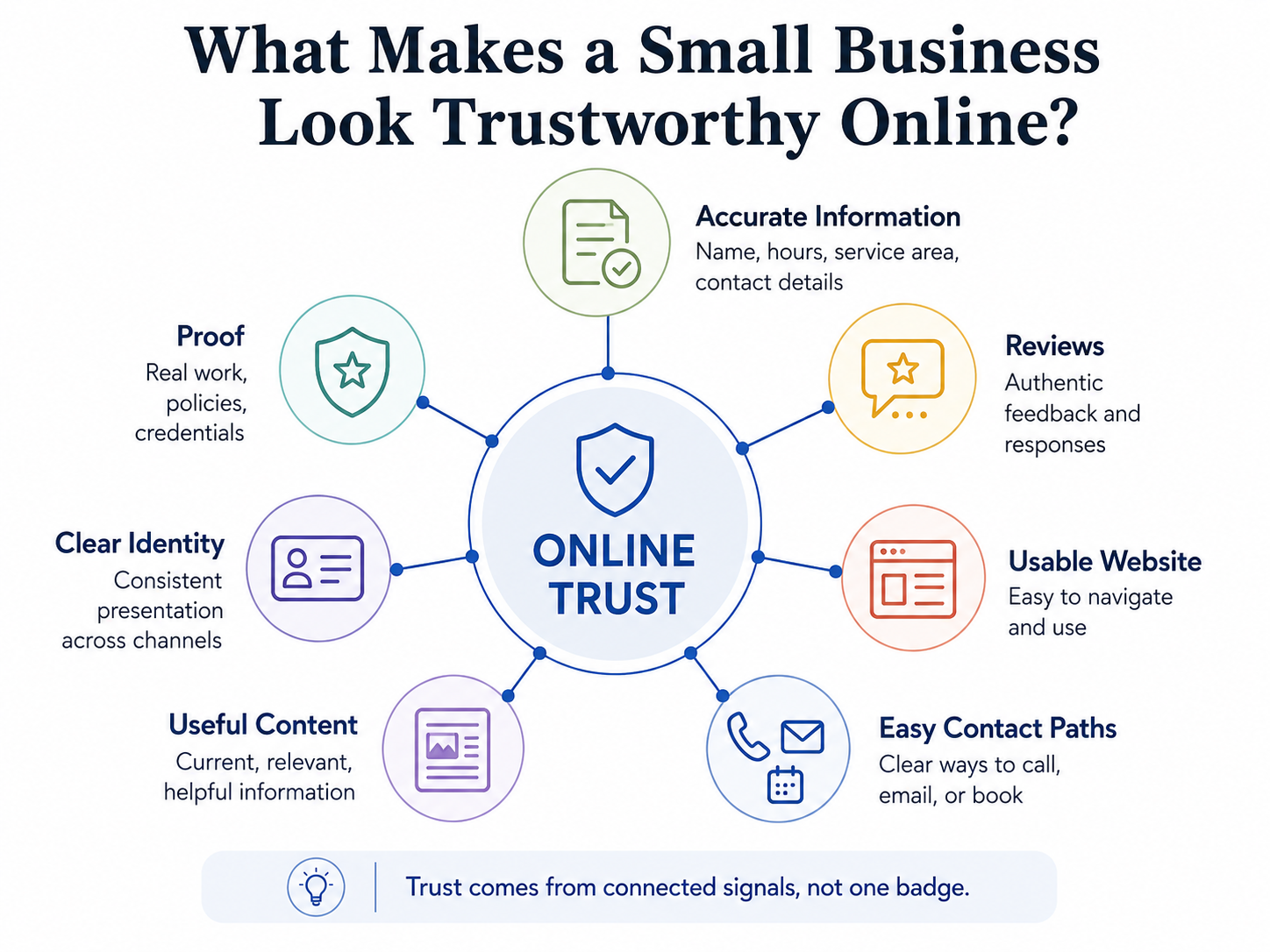
Reviews matter because customers can see what other people say and how the business responds, but there is no universal review count that makes a business trustworthy. Recency, relevance, category expectations, authenticity, and the overall pattern all matter.
Current content also matters. A website, profile, or social account does not need constant activity simply to look alive, but obviously stale information, broken pages, old hours, abandoned offers, or outdated staff details can make customers hesitate.
Visual identity contributes to trust when it makes the business feel consistent and intentional across the places customers see it. That does not mean every small business needs elaborate branding. It means the name, logo, colours, photography, tone, and presentation should help people recognize that they are dealing with the same real business.
Usability is part of credibility too. If a site is difficult to use on a phone, contact information is hidden, forms fail, links are broken, or important information is hard to find, customers may interpret the friction as a sign of how the business operates even when that conclusion is not fair.
The practical goal is not to manufacture trust with tricks. It is to remove avoidable reasons for doubt and give customers enough accurate information and proof to make a reasonable decision.