Start with how your customers actually look for help
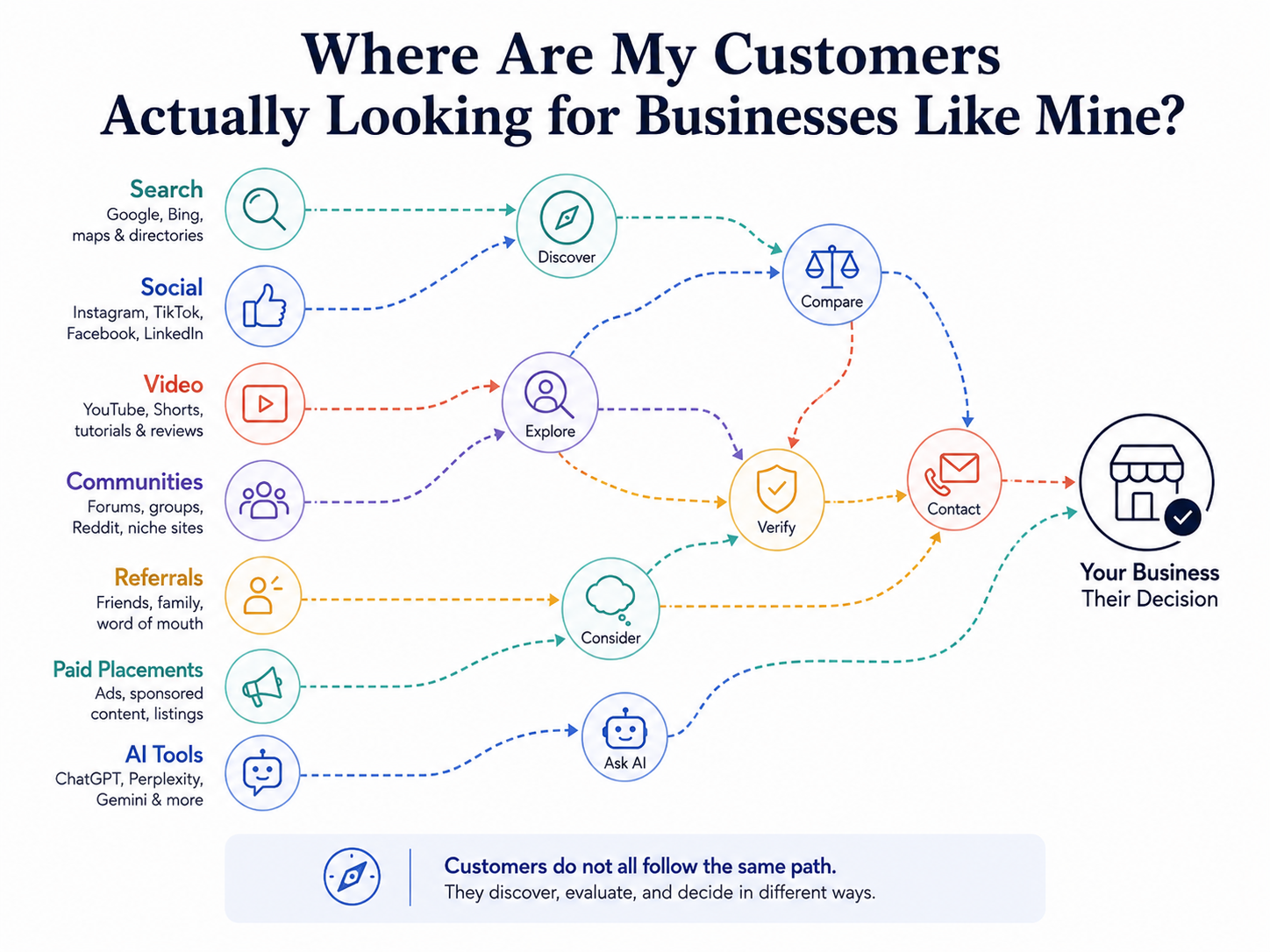
Your customers may find you through Google, a recommendation, social media, video, an online community, an advertisement, or an AI-assisted answer. The important part is not knowing every possible channel. It is knowing which ones matter when your customers are actually trying to solve the problem you help with.
Platform popularity alone cannot answer that. A channel can have millions of users and still be a poor fit for your customers, your buying process, or the kind of information people need before choosing you. Ask whether the problem is urgent or planned, whether customers need someone nearby, whether they compare several options, whether trust matters heavily, and whether the service is easier to understand by reading, seeing, or asking someone.
Search engines and map results can matter when someone is actively looking for a service, product, place, or nearby business. The practical check is whether people can quickly find accurate information about your name, service area or location, hours, services, reviews, contact details, and website.
Get Found5 min read
Why Isn’t My Business Showing Up on Google?
If people can only find your business when they already know your name, there can be several reasons. A good place to start is with the factors Google itself describes for local results.
Social media can also be part of active research, but behaviour differs by age, category, geography, and purchase risk. The useful question is not simply “Should we be on social?” It is which social places your customers use while researching something like this, and what would help them there.
Content & Social8 min read
Which Social Media Platform Should My Business Actually Use?
You probably do not need to be active on every social platform. Choose the few places that match how your customers research, the proof and content your business can produce, and what you can maintain consistently.
Video earns its place when customers benefit from seeing a process, understanding what to expect, comparing options, or judging expertise. Communities and referrals matter when buyers want reassurance from people other than the business itself. Listening to the questions people ask can be as useful as promoting yourself there.
AI-assisted discovery is real but easy to overstate. Treat it as another possible discovery surface, not a replacement for search, websites, referrals, or social platforms. The safer planning approach is to understand the information customers need and make that information clear and consistent across the channels that actually matter to them.
A practical channel plan should answer three things: where customers discover options, where they verify and compare them, and where they take the next step. Those places may be different, and the mix can change by service or customer type.