Why Isn’t My Business Showing Up on Google?
If people can only find your business when they already know your name, there can be several reasons. A good place to start is with the factors Google itself describes for local results.

If you are putting time or money into marketing, you should be able to answer a simple question: is it helping more of the right people find you, contact you, and become customers?
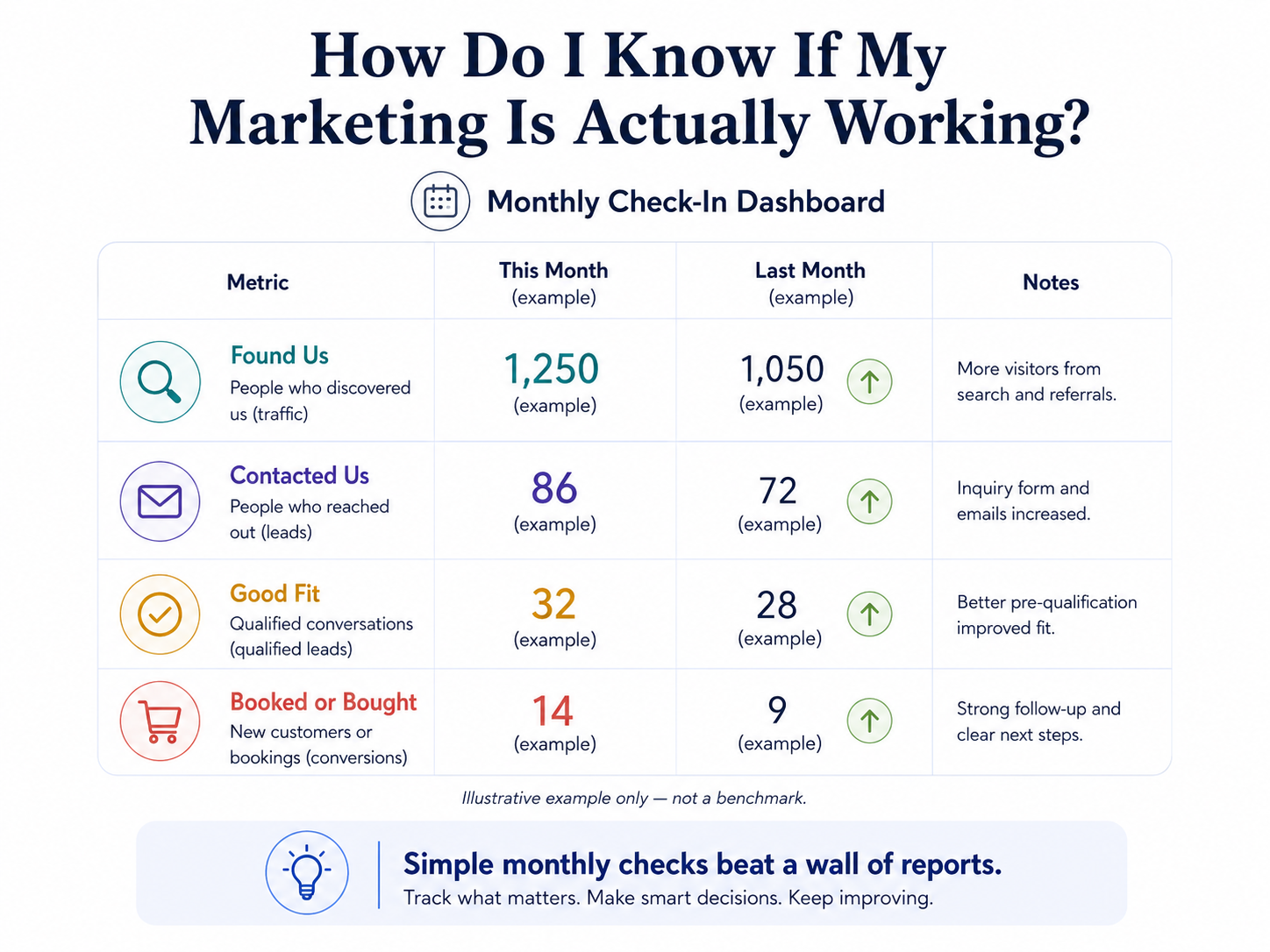
A practical way to tell is to track the same few stages each month: how many suitable people found you, how many contacted you, how many were a good fit, and how many became booked work or purchases when you can record that reliably. Then look for the first stage where the numbers weaken.
You do not need a wall of reports to answer that. You need a clear view of what happens between someone discovering your business and real work coming through the door.
A useful way to think about it is:
Found you → looked closer → contacted you → was a good fit → booked or bought
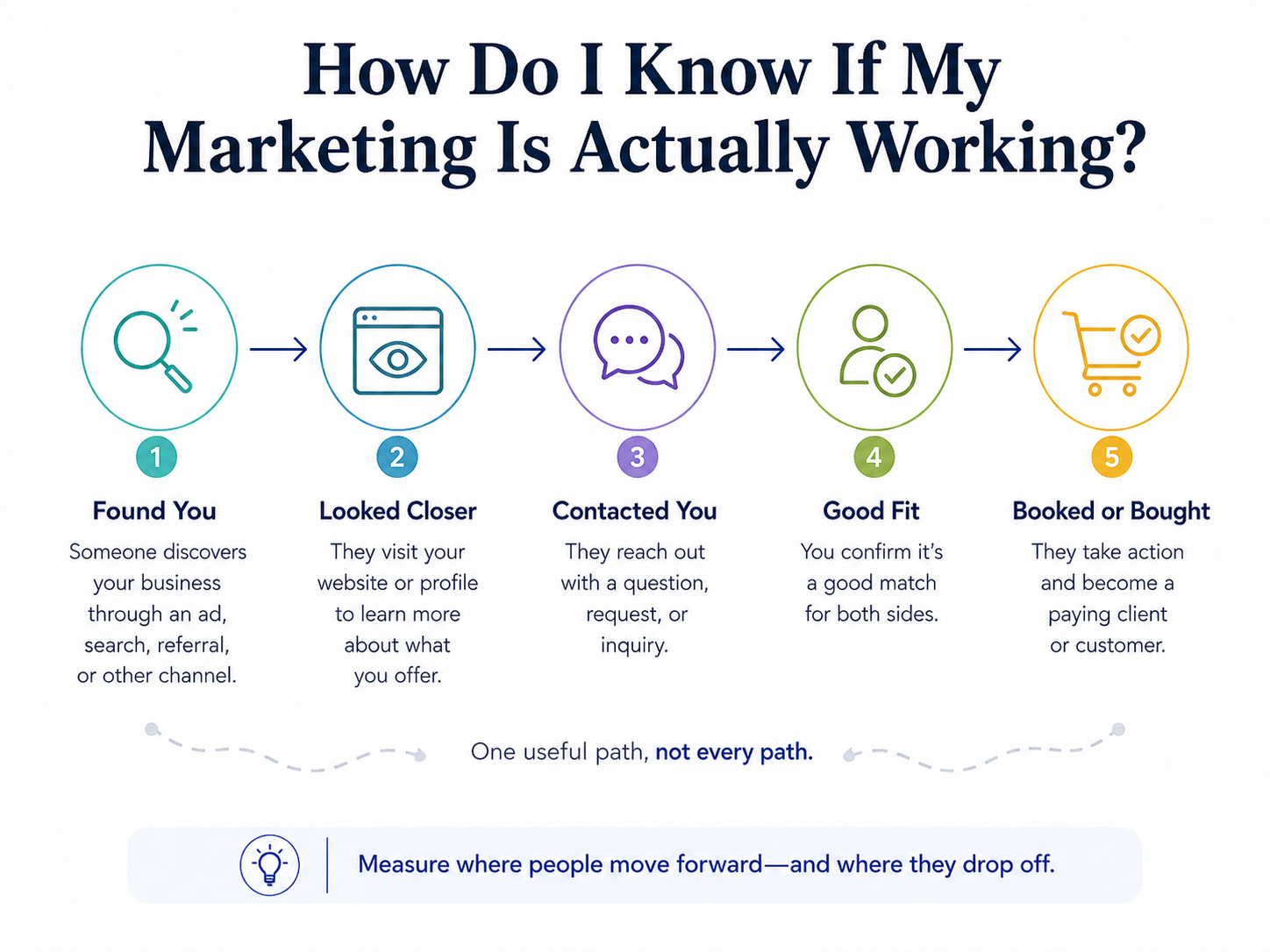
Marketing can help with the early parts of that path. But it does not control everything that happens after someone gets in touch. Response time, quoting, availability, pricing, follow-up, and the customer experience can all affect what happens next.
That is why the goal is not to prove that every dollar or every post caused a purchase. The goal is to see where things are working, where people are dropping off, and what deserves your attention next.
Clicks, likes, and website visits can be useful signals, but they are not the end result in this article. The goal is more of the right work.
So start there and work backward.
If you run a service business and want more booked jobs, ask:
That order helps you avoid getting distracted by a number just because it went up.
For example, a social post can get fewer likes than usual and still bring in a useful enquiry. Website visits can drop while the number of good enquiries stays steady. A Google profile can be seen more often without producing more calls.
The number only matters when you know what it is helping you understand.
Start at the beginning. Can people discover the business when they search for what you do, ask for recommendations, see your work online, or come across your name elsewhere?
Useful signs might include more people finding your website through Google, more people viewing your Google Business Profile, more visits to important pages, or more people mentioning that they found you online.
You do not need all of those. Choose the ones that match how customers usually find a business like yours.
If people are not finding you in the first place, that is the problem to investigate before worrying about what happens later.

If people can only find your business when they already know your name, there can be several reasons. A good place to start is with the factors Google itself describes for local results.
Being found is only the first step. People still need enough information and confidence to decide whether you are worth contacting.
Look at the basics from a customer’s point of view:
If plenty of people are finding you but very few are getting in touch, this is often the better place to look.

One number cannot prove a website lost a customer. Instead, look for specific points where people could get confused, lose confidence, get stuck, or fail to complete the next step.
Next, count the genuine enquiries coming into the business.
That can include phone calls, emails, website forms, booking requests, or direct messages when customers actually use them to ask about your services.
The important thing is to decide what counts and keep that definition consistent.
A spam message is not an enquiry. A job application is not an enquiry. A supplier trying to sell you something is not an enquiry.
You do not need a complicated system. You just need to know how many real potential customers raised their hand.
More enquiries are not automatically better.
If ten people contact you but eight are outside your service area, want something you do not offer, or are looking for a price point you cannot reasonably provide, the raw number can make the month look stronger than it really was.
A simple check is enough: how many of the people who contacted you were people you could realistically help?
This is especially useful when your marketing seems busy but the business still feels like it is talking to the wrong people.
The goal is not to judge every customer before speaking with them. It is simply to notice whether your marketing is attracting people who make sense for the business.
This is where the picture can change.
If good-fit enquiries are arriving but very few become booked jobs or purchases, more marketing may not be the first fix.
Look at what happens after the enquiry:
Those are real business problems, but they are not all marketing problems.
We should be clear about that. Our work can help more of the right people find a business, understand it, trust it, and get in touch. We should not pretend to control what happens inside a client’s quoting, follow-up, scheduling, or customer-service process.
Online tools can give you plenty of numbers because numbers are easy to display.
Views, likes, followers, website visits, profile views, and clicks can all tell you something. But none of them, on their own, tells you whether the business is healthier.
A useful report should help you answer a business question.
If website visits increased, did more people contact you?
If more people saw your Google profile, did calls or direction requests change?
If a post reached fewer people, did it still reach someone who became a good customer?
If a number changes but you cannot explain why it matters, it probably does not deserve much attention yet.
A useful monthly review can fit on one page.
Keep track of:
If it helps, put those same checks into one simple table and use the same rows every month:
Stage | What to record each month |
|---|---|
Found you | One or two measures that match how customers usually discover you, such as useful website visits, Google Business Profile activity, or known referral sources |
Contacted you | Genuine enquiries by phone, email, form, booking request, or direct message |
Good fit | How many enquiries were for work you could realistically take on |
Booked or bought | How many good-fit enquiries became work, when you can record this reliably |
What changed | Promotions, new pages, seasonality, service changes, staffing changes, pricing changes, or other events that could affect the month |
The point is not to create perfect reporting. It is to make the same basic checks often enough that patterns become visible.

One month can be misleading.
Weather changes. Holidays happen. Busy seasons begin and end. A large project can distort the numbers. A promotion can create a temporary spike. A small business may simply not have enough enquiries in one month to treat every change as a meaningful pattern.
Compare a few months when you can. If the business is seasonal, compare similar times of year. If you made a major change to the website or your marketing, note when it happened and watch what changes afterward.
The goal is not to excuse a weak result. It is to avoid making a big decision because of one unusual month.
Once you have a few months of records, look for the first place the path keeps weakening. This is a diagnostic, not a universal benchmark. Compare your own stages over time rather than looking for one “good” rate that applies to every business.
What you see | First place to investigate |
|---|---|
Too few suitable people are finding you | Visibility and discovery: whether you are showing up where customers actually look |
People find you, but few contact you | Clarity and trust: what you offer, proof, useful information, the website experience, and how easy it is to get in touch |
Plenty of enquiries arrive, but few are a good fit | Audience and message: who the marketing is reaching, service area, what you appear to offer, and expectation or price mismatch |
Good-fit enquiries arrive, but few become work | Response, quoting, availability, pricing, follow-up, or another sales or operations issue. More marketing may not be the first fix |
Sometimes marketing is doing its part and the next problem sits elsewhere.
Imagine that a business is receiving a steady number of good enquiries, but replies often take two or three days. Quotes go out inconsistently. The schedule is full for weeks. Customers regularly get confused after the first conversation.
Bringing in even more enquiries may add pressure without fixing the real issue.
In that situation, the more useful question is not “how do we get more people to contact us?” It is “what is stopping the people who already contact us from moving forward?”
That may be a process, staffing, pricing, follow-up, capacity, or customer-service issue.
A trustworthy marketing partner should be willing to say so.
Start simple.
You can learn a lot from a basic monthly record that includes:
You can improve the system later if a better setup would answer a useful question. There is no reason to build a complicated reporting process before you know what you need it to tell you.
It is easy to decide that Google, social media, articles, email, or another part of your marketing “doesn’t work.”
Before you stop, ask:
That gives you a much stronger basis for a decision than looking at one disappointing number.
If you want a simpler way to judge whether your marketing is helping, come back to these three questions:
If you can answer those, you are already in a much better position to decide what needs fixing next.
You probably do not need more numbers. You need clearer ones.
If you already have reports or numbers but still cannot tell what they mean for the business, a second set of eyes can help separate what matters from what does not.
If an article helped you identify the problem but the next step is still fuzzy, tell us what you are working through and we can start there.
Content pending approval.

If people can only find your business when they already know your name, there can be several reasons. A good place to start is with the factors Google itself describes for local results.

One number cannot prove a website lost a customer. Instead, look for specific points where people could get confused, lose confidence, get stuck, or fail to complete the next step.