Do I Actually Need a Marketing Agency Yet?
You can know your marketing needs work without being ready to hire an agency.

The price of marketing help can range from a small one-time expense to several thousand dollars a month because “marketing help” is not one job.
Before comparing prices, compare the responsibility. A person updating one profile, a freelancer building a website, and a team coordinating several parts of your marketing are solving different problems.
As of August 2026, Canadian freelance marketplace data commonly puts mid-level specialists in roughly the C$45–C$100-per-hour range depending on the discipline.[1] Agency marketplace figures are often higher and are frequently reported in U.S. dollars.[8] Those figures are useful for orientation, but they are not Brightside prices or universal Canadian small-business averages.
The detailed examples below are split into Canada-wide provider pricing, Edmonton-local published pricing, and Canadian freelancer rates.
A quote should make it clear what the provider is taking responsibility for. That may include planning, writing, design, website work, local listings, social content, reviews, advertising management, production, measurement, or coordination with other specialists.
Two proposals with different prices may not be competing for the same job at all. A lower price can be completely appropriate for a narrow task. A higher price can be reasonable when it includes more work and coordination. Neither price proves quality on its own.

You can know your marketing needs work without being ready to hire an agency.
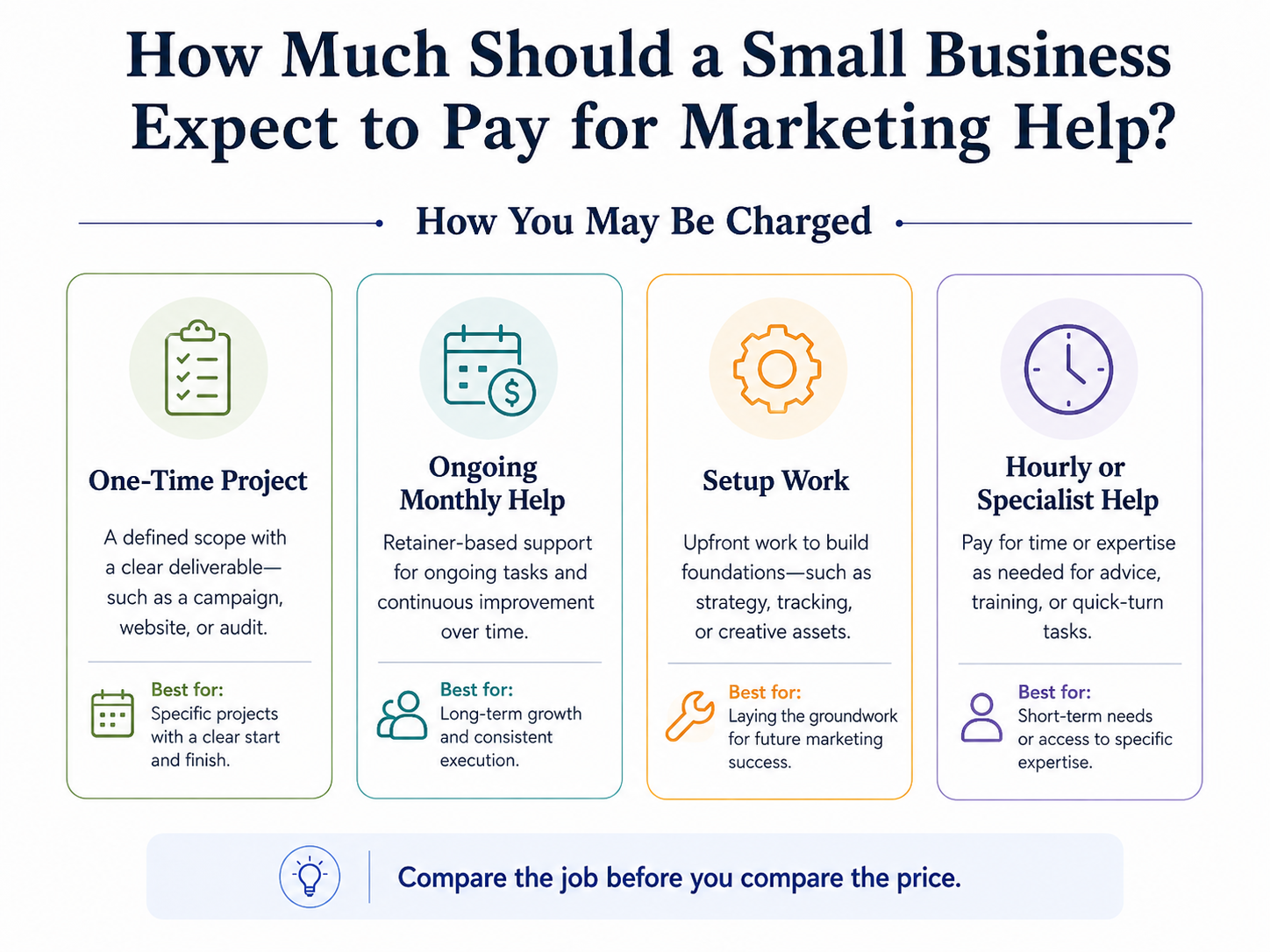
Most arrangements are easier to understand when you put them into four plain categories:
A defined piece of work with a beginning and an end, such as a website, brand identity, audit, or set of pages.
Recurring work such as updates, content, local visibility work, review support, website improvements, advertising management, or planning.
Heavier work at the beginning: account access, audits, templates, research, cleanup, or initial production before the regular work begins.
Useful for troubleshooting, training, technical fixes, account recovery, or other work whose size is difficult to predict in advance.
A recurring agreement is not automatically better than a project. If the problem is genuinely one-time, a project may be the cleaner choice.

The numbers below are dated planning references from public provider pages and neutral marketplaces. Canadian freelancer figures are in CAD. Agency-marketplace figures are left in USD where that is how the marketplace reports them, while provider-page prices are reproduced as published. Scope, seniority, geography, production needs, revisions, and complexity can move a quote well outside these ranges.
Public pricing from several providers that state they serve businesses across Canada gives a concrete national reference. These are published examples, not a national average.
Type of work | Published Canada-wide examples, checked August 2026 | What the spread shows |
|---|---|---|
Website care | SiteCrate from $49/month; DigiTech Solutions from $99/month; SearchSpruce from $120/month; MarketingHub from $149/month.[16][17][15][19] | Care plans can differ in hosting, update time, reporting, security work, and hands-on support. |
Small-business website projects | The SEO Pros $499–$3,500; SiteCrate from $997; DigiTech Solutions from $999; SearchSpruce from $2,500; MarketingHub $3,499 for a standard business website.[18][16][17][15][19] | A fast brochure site, a larger custom site, and a site with deeper SEO or ecommerce work are different purchases. |
Ongoing SEO | DigiTech Solutions from $199/month; The SEO Pros $250–$950/month for local SEO and $350–$900/month for broader SEO; MarketingHub from $499/month for local SEO and $1,499/month for its standard SEO program; SearchSpruce from $700/month.[17][18][19][15] | “SEO” can describe very different amounts of technical work, content, local-search work, and ongoing management. |
Social-media management | The SEO Pros $299–$999/month; DigiTech Solutions $399–$799/month; MarketingHub $499–$1,999/month.[18][17][19] | Posting volume, client-supplied versus original content, platform count, and reporting can materially change the fee. |
Paid-ad management | DigiTech Solutions from $399/month; MarketingHub from $499/month for Google or Meta management.[17][19] | Management fees need to be separated from the media budget paid to the ad platform.[13] |
A separate check of publicly listed Edmonton pricing on August 25, 2026 found the following examples:
Type of work | Published Edmonton examples | What the spread shows |
|---|---|---|
Website projects | OnePoint Solutions from $499; Kiln Design Co from $799; MayaWeb from CAD $1,499; Choice OMG from CAD $3,000.[20][21][22][23] | A small launch site and a larger custom business site are different purchases. |
Website care | Kiln Design Co from $49/month; Choice OMG from CAD $150/month.[21][23] | Ongoing care can range from basic maintenance to more active support. |
Social-media management | Built to Simplify $250/month; OnePoint Solutions from $300/month; Entropy Creative CAD $1,700/month.[25][20][26] | Content volume, original production, strategy, and account management can change the fee substantially. |
Local or ongoing SEO | OnePoint Solutions $300/month for its website clients; MayaWeb from CAD $499.99/month; TML Agency from $500/month; Kiln Design Co from $650/month; Choice OMG from CAD $800/month for local SEO and CAD $1,500/month for broader SEO; A Creative Agency from $1,400/month; Top Draw from $2,500/month.[20][22][24][21][23][27][28] | The label “SEO” can cover very different amounts of technical work, content, local-search work, authority building, and management. |
Audits and diagnostics | OnePoint Solutions AEO audit $499; DecodeLocal Edmonton SEO audit $899.[20][29] | A diagnostic is a different purchase from ongoing execution. |
Broader monthly marketing | Entropy Creative publishes CAD $1,700/month and CAD $2,500/month packages; Top Draw starts broader digital-marketing packages at $3,500/month.[26][28] | Bundled support becomes more expensive as the provider takes responsibility for more channels, production, and coordination. |
These are point-in-time published examples, not an Edmonton market average. The packages are not equivalent, and the sources do not all label currency the same way, so the figures are reproduced as published rather than silently converted or normalized.
The numbers below are dated planning references from neutral marketplaces. Canadian freelancer figures are in CAD. Scope, seniority, geography, production needs, revisions, and complexity can move a quote well outside these ranges.
Service | Canadian freelancer planning reference |
|---|---|
Website | C$55–C$95/hour; medium projects C$1,650–C$9,000.[2] |
Brand identity | C$50–C$85/hour; logo C$750–C$4,200; fuller identity C$2,000–C$11,200.[3] |
Social media | C$45–C$78/hour; monthly management examples C$900–C$5,000.[4] |
Local search / SEO | C$58–C$100/hour; audit C$870–C$4,800; monthly examples C$1,160–C$6,400.[5] |
Paid advertising management | C$58–C$100/hour; monthly examples C$1,160–C$6,400 before ad spend.[6] |
Writing/content | Copywriters C$48–C$82/hour.[7] |

Agency, freelancer, and in-house marketing can all be the right choice. Compare breadth, continuity, direct access, management time, and the kind of capability your business actually needs.
The table is more useful as a comparison tool than as a shopping list. For example, a C$2,000 website project and a US$10,000 agency project may differ in number of pages, research, writing, design, photography, development, integrations, project management, and ongoing support. The headline price alone does not tell you which is appropriate.
Bundled monthly marketing is even harder to summarize with one number. Clutch’s July 2026 data shows digital-marketing agency engagements across a very broad global span, which is useful mainly as evidence that bundled scope varies enormously—not as a Canadian small-business benchmark.[8]

The quoted professional fee is not always the full cash cost of the work. A useful check is:
All-in cash cost = provider fee + media spend + software/hosting/licences + production + outside specialists + usage charges
Ask whether the quote also requires money for:
A clear quote should separate professional fees from these third-party costs. If you pay a provider to manage advertising and also pay Google or Meta for the ads themselves, both belong in the real cost of the work.

There is no useful universal marketing percentage for every small business. A better budget starts with goals, economics, capacity, channel costs, and what the business can realistically follow up on and sustain.
Most price differences come back to the amount and difficulty of the work. Look at:
Owner knowledge can reduce guesswork, but it does not necessarily reduce labour. A provider may still need time to turn that knowledge into useful pages, designs, campaigns, or systems.
Before comparing the headline prices, make sure you understand the work behind each quote. The question list near the end of this article gives you a quick way to check; the sections above explain why those differences matter.
A quick side-by-side check can also help:
Compare this | What you need to know |
|---|---|
Work included | Are both providers actually doing the same tasks and creating the same deliverables? |
Volume and frequency | Are they producing the same number of pages, posts, campaigns, revisions, meetings, or updates? |
Responsibility | Who plans, writes, designs, publishes, manages approvals, measures, and coordinates other specialists? |
Separate costs | Are media, software, hosting, production, travel, specialists, or usage charges inside or outside the fee? |
Commitment and ownership | How long are you committed, how do you leave, and who owns the accounts, files, website, and finished work? |
If those five rows do not match, the proposals are not yet comparable.
Clear boundaries are useful. “Everything included” is only meaningful if you know what “everything” means. Social media could mean two posts a month or daily production. Website support could mean occasional edits or a rebuild. Advertising could include management, media spend, or both.
The answer is not always to find a cheaper version of the same package. Sometimes the job should be smaller.
If one website problem is blocking enquiries, fix that before buying a broad program. If one public profile matters most, keep that accurate before maintaining five channels. If the business needs a finite project, do not turn it into a monthly agreement simply because monthly help is available.
A smaller job with a clear purpose can be a better purchase than a large package the business cannot maintain.
Before deciding that one quote is cheaper than another, make sure you can answer these questions about both:
If any answer is unclear, the fuller sections above explain why that question matters.
Two quotes can look similar on price while covering very different amounts of work. Get the differences clear before choosing between them.
These are not questions we only expect you to ask someone else. Brightside’s services are structured so you can understand what we would do, what would stay with you, what is included, what may cost extra, who owns the work and accounts, and how the relationship works before you decide.
You should be able to compare us with another option using the same standard.
Brightside does not publish one fixed public price for marketing help because the price follows the work being proposed. A defined one-time project, ongoing support, and a broader engagement can involve very different deliverables, production, channels, locations, specialist work, and third-party costs. We define that scope first, then price the work involved. The price is based on the job, not what we think a particular customer can pay.
Book a conversation with Brightside. We’ll walk through the work, responsibilities, costs and fit clearly so you can decide whether it makes sense.
Expect the price to follow the amount of work, responsibility, and specialist skill involved. Use dated market ranges to identify obviously unusual expectations, then judge the actual proposal by what it includes and what remains your responsibility.
The most useful comparison is not “Which monthly fee is cheaper?” It is “Are these providers solving the same problem, and is this the right amount of help for us right now?”
If you cannot answer that, define the job before choosing the provider.
If an article helped you identify the problem but the next step is still fuzzy, tell us what you are working through and we can start there.
Content pending approval.

You can know your marketing needs work without being ready to hire an agency.

There is no useful universal marketing percentage for every small business. A better budget starts with goals, economics, capacity, channel costs, and what the business can realistically follow up on and sustain.